Skin8 min read
What to Expect From a Professional Facial
A step-by-step walk through a professional facial, from the consultation to the massage, and what a facial can and can’t realistically do.

A facial is one of the few beauty treatments people book without quite knowing what happens during it. You lie down, something goes on your face, an hour passes, and you leave looking slightly pink and feeling considerably better. This is what is actually going on, and what a facial can and cannot realistically do.
Before anything starts
A good facial begins with a conversation, not a product.
Your therapist will ask what your skin has been doing lately, what you use at home, whether anything has changed, and whether you have any concerns. It is worth answering honestly, including the unflattering parts: that you have not used sun protection since May, or that you bought an acid exfoliant and have been using it every night.
Mention any prescribed skin treatments, recent injectables, recent sun exposure, and anything your skin reacts to. Some steps need adjusting or leaving out entirely, and the therapist can only do that if they know.
They will then look at your skin properly, in good light. This is not a diagnostic exercise, and a beauty therapist is not a dermatologist and should not present themselves as one, but it does determine which products and steps are chosen for the day.
The double cleanse
Almost every facial starts with cleansing twice, and there is a reason for the repetition.
The first cleanse removes what is sitting on the surface: make-up, sun protection, the day’s grime. The second cleanse can then actually reach the skin and work on its own oils and debris. A single cleanse over a full face of make-up mostly just moves the make-up around.
It is also the point at which most people start to relax, because a professional cleanse involves considerably more massage than the thirty seconds most of us manage at the sink.
Exfoliation
The skin sheds dead cells continuously, and they do not always leave cleanly, which contributes to dullness, rough texture and blocked pores.
Exfoliation in a facial might be physical, using a fine granular product, or chemical, using acids that loosen the bonds between dead cells. Which one is used, and how thoroughly, is a judgement call based on your skin that day.
If your skin is sensitive, reactive, or currently irritated, this step may be softened or skipped entirely. That is not the therapist cutting corners. It is the correct decision. A facial that leaves your skin worse than it started is a failed facial, however thorough it felt.
Extractions
Not every facial includes them, and they should never be assumed.
Extraction is the manual clearing of blocked pores, usually after the skin has been softened with warmth or steam. Done properly, on skin that is genuinely ready, it is uncomfortable but brief. Done aggressively, it damages the skin and can leave marks that last far longer than the blockage would have.
You are entitled to ask for extractions to be skipped, and a good therapist will stop if you say the word. If you are prone to marking after any kind of trauma to the skin, say so beforehand.
Mask and massage
The mask is chosen for what your skin needs, whether hydration, calming, or drawing out congestion, and left on for ten to fifteen minutes.
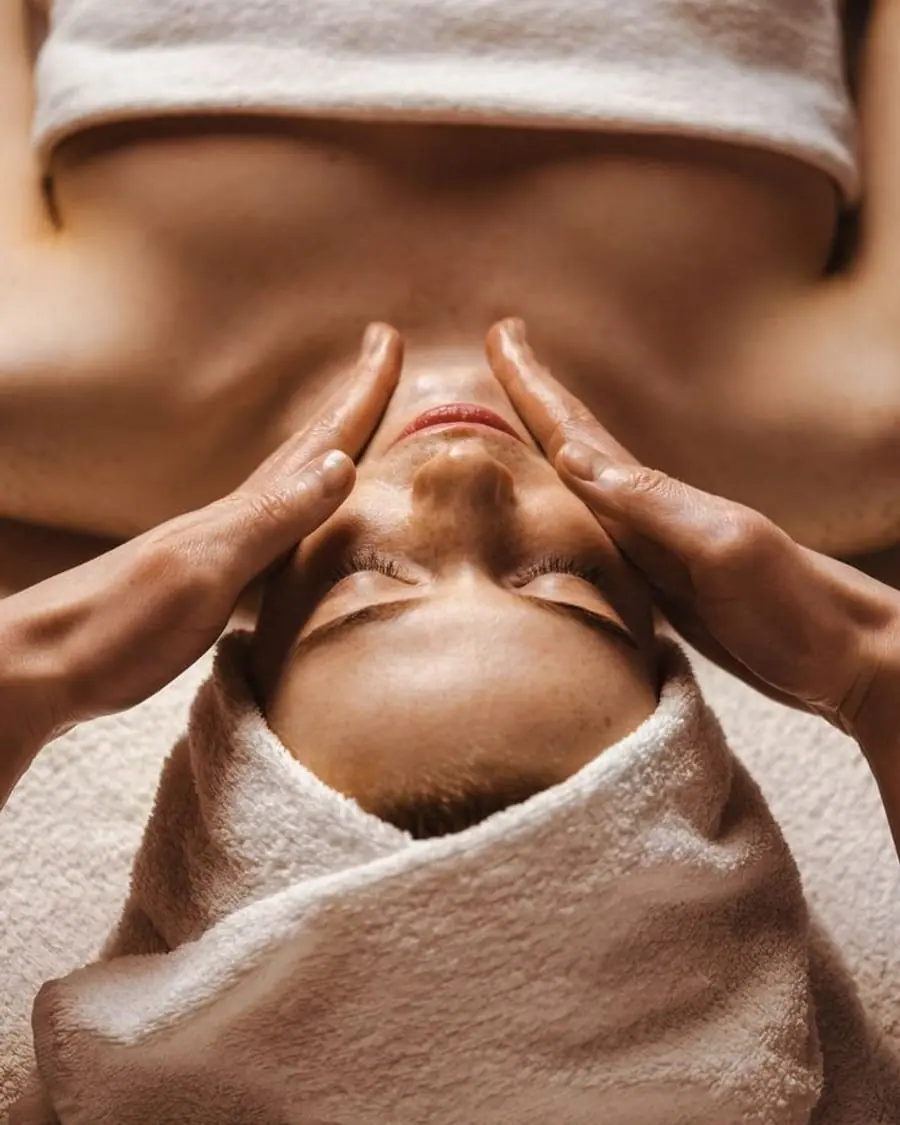
This is usually when the massage happens, and for most people it is the heart of the treatment. Working through the shoulders, neck, face and often the scalp, it releases tension people did not know they were holding, particularly around the jaw and temples.
It is also the point at which a surprising number of people fall asleep. Nobody minds.
Finishing
Serum, moisturiser and sun protection are applied. Sun protection matters especially if you have been exfoliated, because the skin is temporarily more light-sensitive.
The therapist should then talk you through anything worth changing at home. This part is often more valuable than the treatment itself. If your routine has grown into eleven products that fight each other, an outside opinion is genuinely useful, and a good therapist will tell you what to stop using as readily as what to start.
What you will look like afterwards
Slightly pink, well-massaged, and probably a bit dazed. The pinkness settles within an hour or two.
Your skin will feel soft and look brighter, largely because of the improved circulation and the removal of surface dead cells. That immediate glow lasts a day or two; the more meaningful benefits accrue over repeated treatments and, more importantly, over consistent care at home.
Aftercare
- Leave your skin alone for the rest of the day. Ideally skip make-up.
- Use sun protection the following day without fail.
- Hold off on retinoids and acid exfoliants for two to three days.
- Avoid saunas, steam rooms, hot yoga and heavy exercise for 24 hours.
- Do not book anything else that works on the skin immediately afterwards.
The breakout question
Some people notice a few small blemishes in the days after a facial, particularly a first one, and particularly if the skin was congested.
This is common and usually settles within a week. It is not a sign the facial went wrong, and it is not the products “detoxing” your skin either. That is not a thing skin does. It is simply the result of clearing congestion that was already there.
If you are prone to this, or you have an event coming up, say so and the treatment can be kept gentler.
What a facial will not do
This is worth being clear about.
A facial will not permanently shrink pores, remove wrinkles, or replace a routine at home. It cannot treat a medical skin condition: acne, rosacea, eczema and dermatitis all need a GP or dermatologist, and any salon that tells you otherwise is overstepping.
It will not undo years of sun exposure, and no single treatment produces a transformation. Skin cell turnover means genuine change takes six to eight weeks to show, and anything promising results in days deserves scepticism.
What a facial does offer is a deeper clean than you can achieve at home, a proper massage, professional eyes on your skin, and an hour of quiet. Those are real and worthwhile. They are just not miraculous.
Timing it around an event
Do not have a facial the day before something important. Around a week ahead is sensible, and if it is your first facial with a new therapist, have one earlier still so you know how your skin responds.
Our guide to planning beauty treatments before a special occasion sets out where facials sit relative to brows, waxing and everything else.
How often to come back
Every four to six weeks suits most people, roughly matching the skin’s renewal cycle. But a schedule you will not keep is worth less than three well-spaced facials a year that you actually attend. We have written about this properly in how often you should have a facial.
Booking with us
We carry out facials at our salon on Herne Bay High Street, adapting the treatment to your skin on the day rather than working through a fixed routine. If it is your first facial, or your skin is reactive, tell us when you book and we will keep things gentle.
You can read more on our facials page, or see our approach to skincare more broadly. Call the salon on 07337 350130 to book, and feel free to ring just to ask a question about your routine.
Book with us
Have a question about this treatment?
We’re on Herne Bay High Street and happy to talk something through, whether or not you’re ready to book.